

November 16th Research Briefing
A weekly publication of the top three papers from arXiv last week. Papers with arXiv v1 published 2026-11-07 through 2026-11-13 UTC.
Contents
- Look Here, Then Decide: 187 memory-safety bugs, ranked by a 4B model on desk GPUs
- Preserve the Vulnerability, Break the Alert: LLM rewrites hide real flaws from CodeQL
- CyberBinGym: AI agents turn binary patches into working exploits
Look Here, Then Decide: 187 memory-safety bugs, ranked by a 4B model on desk GPUs
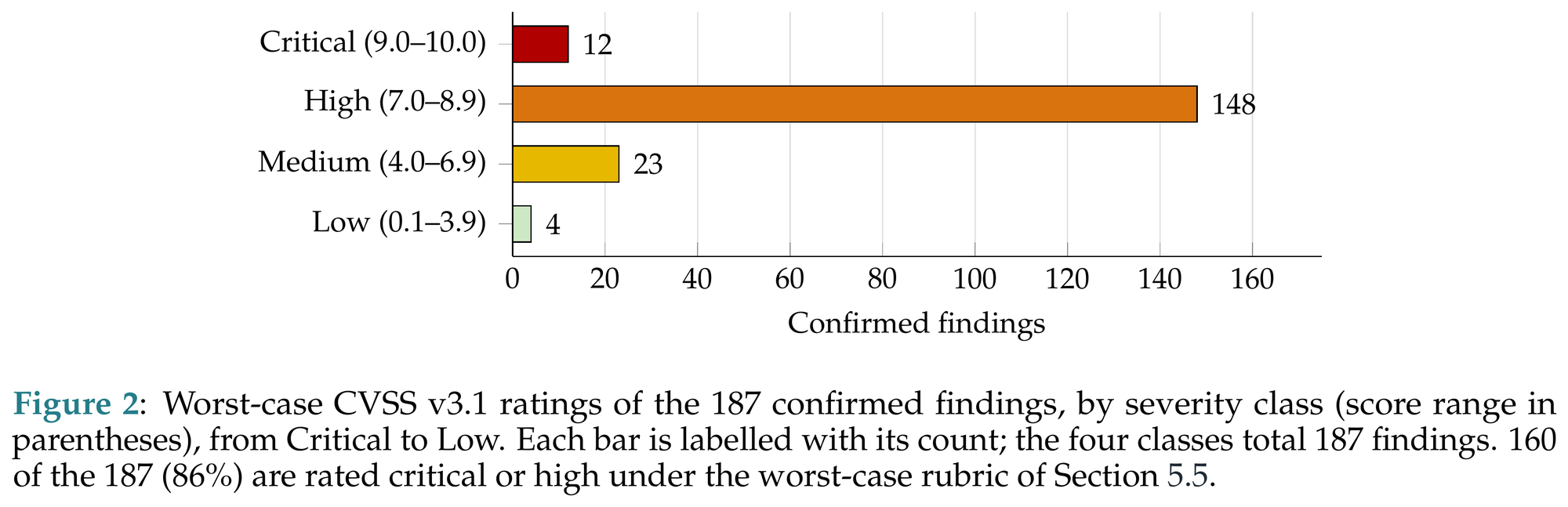
Look Here, Then Decide searched more than 4,000 open-source C and C++ projects and confirmed 187 memory-safety findings. By worst-case CVSS v3.1, 12 are critical and 148 are high. All 12 critical findings are memory-corrupting writes reachable without authentication. The findings are in coordinated disclosure, so the paper names no project.
This matters because the search used no frontier model and ran on three desktop GB10 systems.
The harness picks widely packaged projects with little fuzzing coverage. Deterministic miners look for incomplete security fixes, such as a bounds check added to one copy but not to a similar copy nearby, and localizers flag shapes such as input-derived lengths in buffer writes. Intern-Decision-4B then scores each candidate function in one forward pass. Stronger models and a human verify, and each finding must reproduce as an AddressSanitizer crash and again on a hardened build.
Alone, the model barely separates a vulnerable function from its own patch (AUC 0.56). As a ranker, it put 7.5 times more confirmed findings in the top 10 than random order, which the paper calls a selection-biased upper bound.
Authors: Tim De Wachter, Kyryl Volkov, Myrto Eleftheria Gkogkou, and Mathieu Huysman (paper, pdf). Tim De Wachter: LinkedIn. Mathieu Huysman: LinkedIn.
Preserve the Vulnerability, Break the Alert: LLM rewrites hide real flaws from CodeQL
Preserve the Vulnerability, Break the Alert showed that an LLM can make CodeQL stop reporting a real vulnerability while the flaw stays in the code. On 172 flows that CodeQL detects in real npm vulnerabilities, three rewrites per flow silenced 26.2% of them, at about $0.51 per silenced flow.
This matters because teams often read a clean re-scan as a fix. Automated alert-fixing assistants are judged that way, and developers tend to stop when the alert clears.
The model (Claude Opus 4.7) saw only the source, sink, and flow that CodeQL reports, and rewrote one function as a plausible maintenance change. Manual audits and controlled experiments confirmed that each vulnerability survived. When asked only to refactor the same functions, with no alert in view, the model silenced none.
All 70 silencing rewrites trace to seven gaps in CodeQL's library models, and 64 sit inside APIs that CodeQL already models. The largest is the WHATWG new URL() constructor: taint reaches the query parts but not .pathname, which explains 43 path traversal cases. All seven gaps remain in CodeQL 2.27.3.
Authors: Zhezhen Cao, Weiyuan Ding, and Bowen Xu (paper, pdf). Zhezhen Cao: LinkedIn, GitHub.
CyberBinGym: AI agents turn binary patches into working exploits
CyberBinGym gave AI agents stripped vulnerable and patched binaries for 100 real vulnerabilities in 53 open-source projects, with no source code and no description of the bug. The best agent, Codex with GPT-5.6, triggered the target vulnerability in 88% of tasks and built a working exploit in 20%.
This matters because fixes ship as binaries while many systems stay unpatched for months. If an agent can turn a patch diff into an exploit, defenders get less time.
Each task has two checks. A proof of concept must crash the vulnerable build under a sanitizer but not the patched build. An exploit must read a root-owned flag from a victim service, and trajectory audits reject reward hacking. Claude Code with Claude Opus 5 recovered 85% and exploited 6%. Kimi Code with Kimi K3 recovered 64% and exploited none.
The patched binary helps: on a matched 20-task subset, it raised the Codex exploit rate from 10% to 25%. With stack canaries, PIE, full RELRO, and Fortify on, Codex still exploited 2 of its 20 earlier successes.
Authors: Lambang Akbar Wijayadi, Zhaoqi Xiao, Zhun Wang, Hongwei Li, Wenbo Guo, Heng Yin, Zhenkai Liang, and Dawn Song (paper, pdf). Wenbo Guo: X, LinkedIn, GitHub. Heng Yin: X, LinkedIn. Dawn Song: X.