

November 23rd Research Briefing
A weekly publication of the top three papers from arXiv last week. Papers with arXiv v1 published 2026-11-14 through 2026-11-20 UTC.
Contents
- Mjolnir: 64 new root-of-trust bugs confirmed by maintainers
- ChainAgent: an LLM agent chains PHP flaws into nine RCEs
- BlockJack: one bit flip in a vLLM block table leaks another user's context
Mjolnir: 64 new root-of-trust bugs confirmed by maintainers
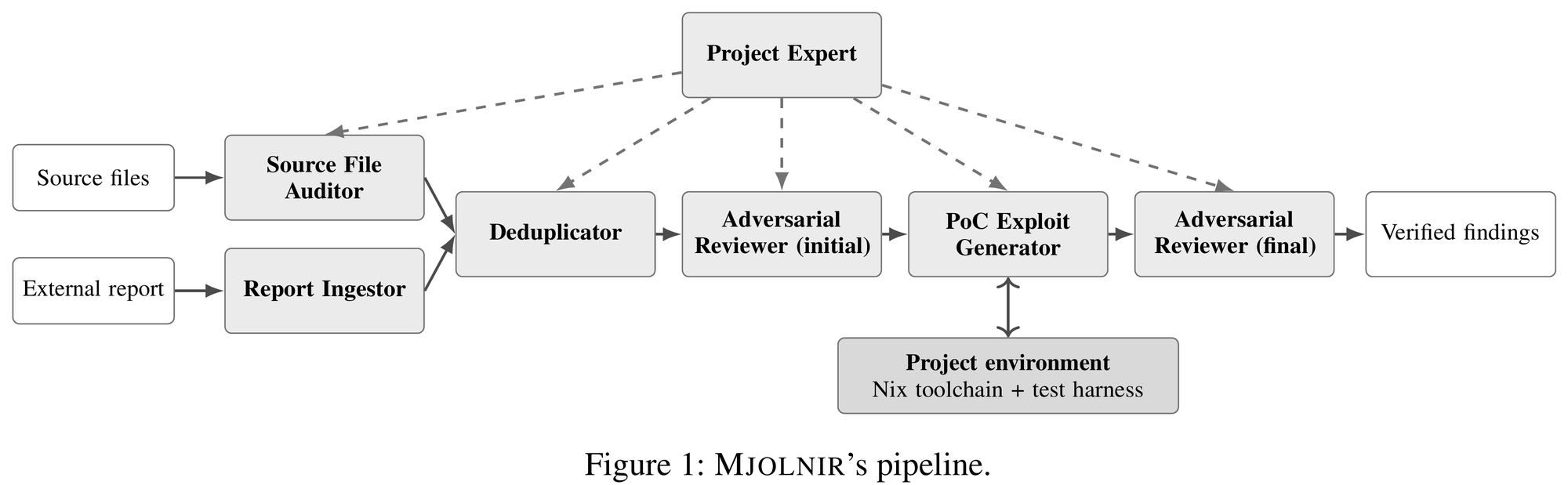
Mjolnir scanned root-of-trust firmware and hardware designs, and maintainers confirmed 64 of its findings as previously unknown security-relevant bugs. The six targets are firmware and RTL in Caliptra, OpenTitan, and OpenPRoT. The paper withholds details of the new bugs while fixes and coordinated disclosure continue.
This matters because a root of trust anchors secure boot and attestation, and bugs in boot ROM or RTL are fixed at fabrication, so they stay in every shipped device. Many RoT bugs are missing authorization checks or fault-injection countermeasures, and they do not crash.
Every agent gets the project's threat model. Auditor agents propose findings, a skeptical reviewer rejects weak ones, and a PoC agent writes each reproduction as a test in the project's own harness. A diff check rejects PoCs that edit production code or mock the target.
On Caliptra's runtime firmware, blind maintainer labels gave 83.3% to 100% precision across three models. On 34 known Caliptra bugs fixed after the models' training cutoffs, Mjolnir found 10 with Gemini 3.8 Flash and 17 with Gemini 4 Argon, against 7 and 12 for the best single-agent baseline.
Authors: Collin MacDonald, Carl Lundin, Stephen Herwig, Miguel Osorio, and Timothy Trippel (paper, pdf, code). Collin MacDonald: X. Timothy Trippel: X.
ChainAgent: an LLM agent chains PHP flaws into nine RCEs
ChainAgent scanned 30 PHP web applications from GitHub (each with more than 1,000 stars) and found 20 vulnerabilities in seven of them. These form 13 exploit chains, and 9 of the chains reach remote code execution. All were validated dynamically and reported to the developers, and 9 of the vulnerabilities have CVE IDs so far.
This matters because high-impact web attacks often combine a weak flaw with another flaw or with normal program behavior. Tools that analyze each flaw in isolation miss the chain.
ChainAgent models vulnerabilities and functional gadgets (intended features that an attacker can reuse) as preconditions and capabilities, and an exploit graph drives the code search backward from unmet preconditions and forward from known capabilities. In one Open Web Analytics chain, a user with settings permission points the error log at a php://filter stream, and a later error writes attacker PHP into a file that the server runs.
Against Codex on 15 PHP applications with the same LLM backends, ChainAgent reached 42.02% to 44.63% recall for goal-reaching components (Codex: 13.03% to 37.46%). The code is not released because of dual-use risk.
Authors: Xinyi Wang, Yeting Li, Shizhe Cui, Jiaming Guo, Qin Mai, Yecheng Sun, Hengyu Yang, Yujie Sun, Huina Chao, Yang Xiao, Feng Li, and Wei Huo (paper, pdf). Yeting Li: GitHub.
BlockJack: one bit flip in a vLLM block table leaks another user's context
BlockJack showed that one fault in the KV cache block table of an LLM serving engine can redirect a request to another user's cached state. In vLLM, this put a victim's context into the attacker's response, or let attacker text steer the victim's answer. vLLM confirmed the vulnerability after disclosure, and vLLM and Sonar implemented patches that the researchers reviewed and tested.
This matters because many tenants share one serving engine, and its block table works like an OS page table. A flipped bit in weights often changes nothing, but one changed block id moves a whole read.
The attacker is unprivileged, shares the physical machine, sends normal API requests, and can cause Rowhammer bit flips. A flip in the attacker's entry causes disclosure, and a flip in the victim's entry causes alteration.
Disclosure worked on seven models from four families. On a 248-scenario medical benchmark, the alteration made 5.2% to 41.1% of answers recommend a lower level of care while still fitting the question. Physical Rowhammer on a DDR4 machine validated disclosure in 3 of 10 campaigns and alteration in 8 of 10, but a kernel module placed the table page for those runs.
Authors: Qifan Wang, Jeremy Boy, Jonas Sander, Yansong Gao, Hongsheng Hu, Ye Dong, Thomas Eisenbarth, and David Oswald (paper, pdf). David Oswald: GitHub.