EXPERIMENT 002 / BLACK HOLE OBSERVATORY
The other side of darkness.
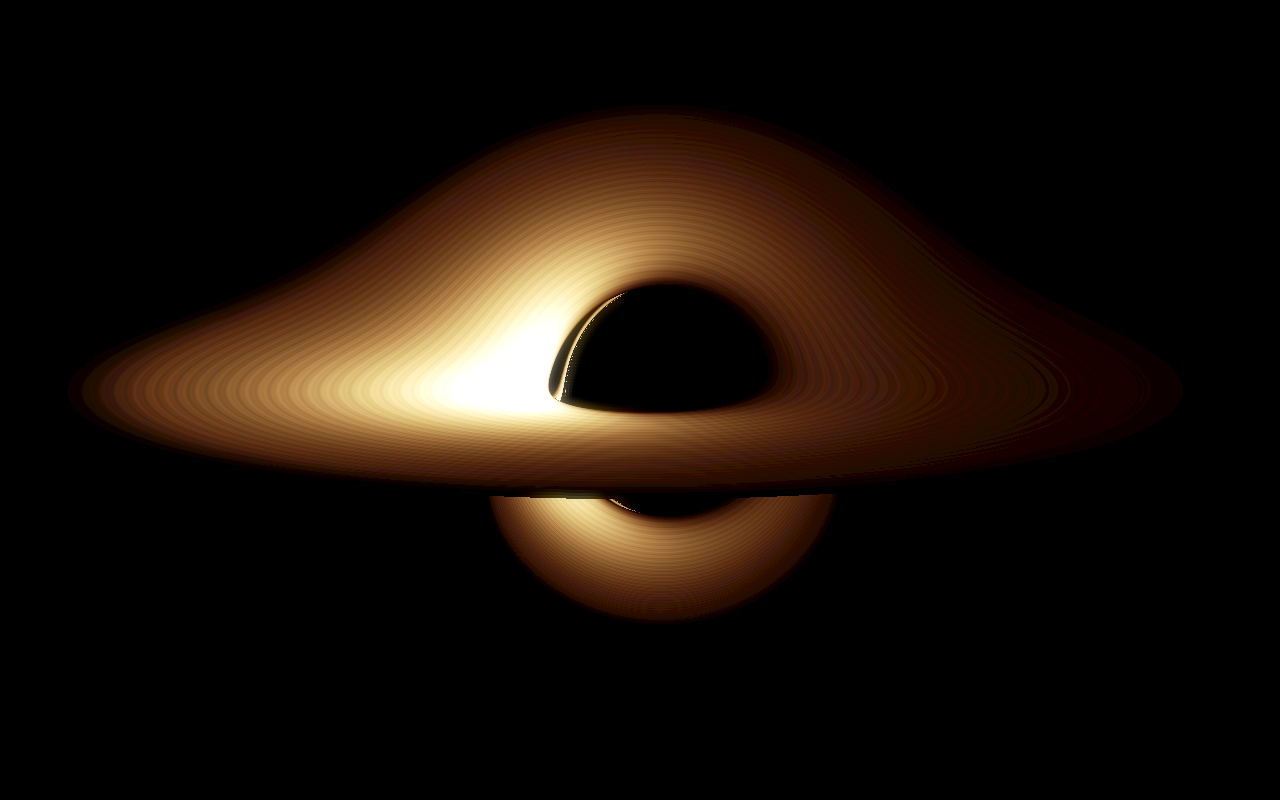
A flat disk should look flat. Near a black hole, its far side rises into an arc. Turn the view, change the spin, and follow the light that makes it happen.
EXPERIMENT 002 / V1
The other side of darkness.
Tilt a luminous disk, change the black hole’s spin, and see what gravity does to the light.
Runs in your browser. Mouse, touch, and keyboard controls.THE MODEL / KERR
The disk is flat. Its image isn’t.
The bright arch is the far side of an equatorial disk, bent into view by gravity. Higher-order images can appear near the shadow. The dark region is shaped by both light capture and the disk’s inner gap; it is not a photograph of the event horizon.
Spin changes the Kerr geometry and the innermost stable prograde circular orbit, where this model’s disk begins. Tilt the observer between 10° and 85° from the spin axis, or compare zero spin with rapid rotation. The observer stays at infinity; framing changes the image scale.
Disk matter follows circular orbits. Its motion and gravity change the light’s frequency, making the approaching side brighter. Switch off frequency shifts to isolate their contribution, or switch off curved light to compare with straight rays through a flat disk.
Each pixel integrates a null geodesic until it meets the disk, reaches the horizon, escapes, or exhausts the step budget. Clicking the image reports a separately computed ray outcome. The renderer sleeps when the view is unchanged.
A PERMANENT RECORD
Two ways to see curved light.
v0 preserves the Schwarzschild star-field experiment, including its orbital-plane ray diagrams. v1 explores matter and spin. The two versions use different observers and units: here, M means GM/c², half the Schwarzschild-radius unit used in v0.