EXPERIMENT 002 / BLACK HOLE OBSERVATORY
At the edge of the visible.
A black hole changes which parts of the universe reach your eyes. Explore a sky of curved light—and follow the paths behind the image.
EXPERIMENT 002 / V0
See where light goes.
Orbit a black hole, change your distance, and inspect the paths that light takes.
Runs in your browser. Mouse, touch, and keyboard controls.THE MODEL / SCHWARZSCHILD
Light takes a different route.
This experiment traces null geodesics in the Schwarzschild geometry, an exact solution of Einstein’s equations for an isolated, nonrotating, uncharged black hole. The spacetime is fixed; the light paths are calculated numerically.
The observer stays outside the black hole, at 6, 8, 12, 20, or 32 Schwarzschild radii. Dragging moves the camera around it. Changing distance selects a new stationary observer rather than simulating a fall.
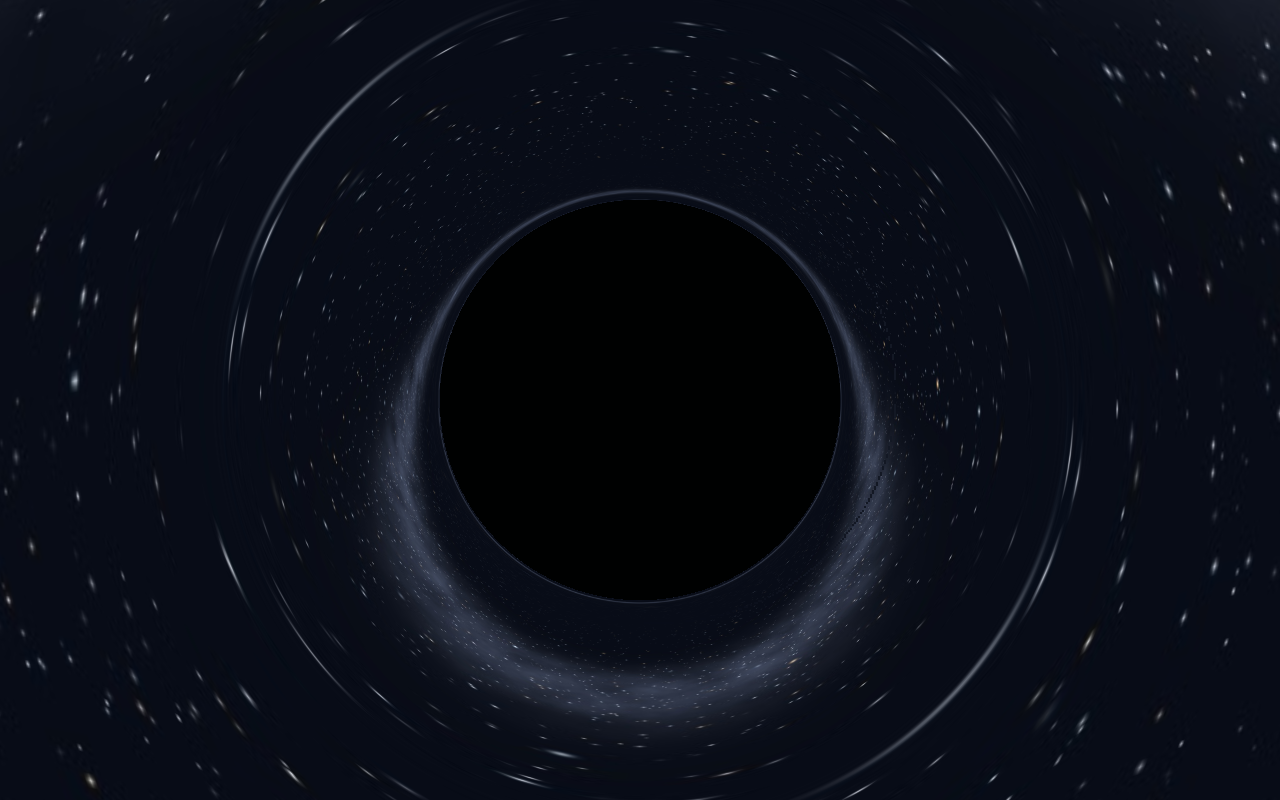
The dark shadow shows directions from which background light cannot reach the camera. Bright arcs are distorted images of the synthetic star field. The shadow’s apparent size differs from the event horizon’s physical radius.
Turn lensing off to compare with straight light in flat space, with no capture shadow. Turn on the celestial grid to make the distortion easier to see. Click the sky or choose a ray preset to inspect the path in its orbital plane.
A PERMANENT RECORD
First the light. Then the matter.
v0 preserves this first lensing experiment. Later versions can add an accretion disk and rotating black holes while keeping this baseline available.